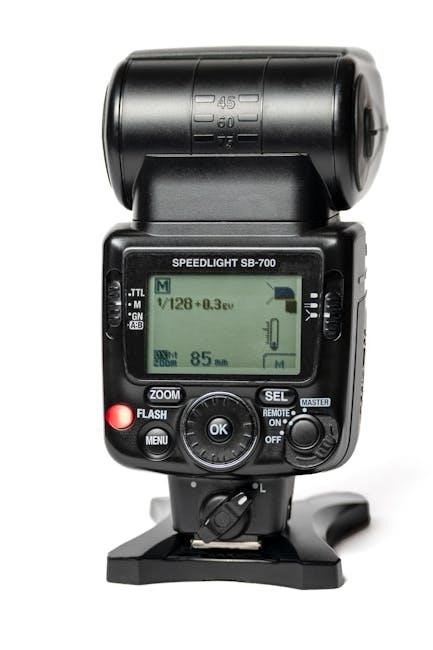
Nikon Speedlight SB-700 User Manual: A Comprehensive Guide
This comprehensive guide details the Nikon SB-700’s operation, covering features like TTL, distance-priority manual, and manual flash modes, alongside compatible camera information.
Downloadable operation manuals, PDF files viewable with free software, are available from Nikon’s download center, offering extensive support for camera flash functionality.
Manualzilla provides a collection of Nikon manuals, including the SB-700 user manual, offering a valuable resource for photography and optics enthusiasts seeking detailed instructions.
The Nikon SB-700 Speedlight is a versatile and powerful flash unit designed to elevate your photography. It’s a crucial tool for Nikon photographers seeking to master off-camera lighting and achieve professional-quality results. This manual serves as a comprehensive resource, guiding you through every aspect of the SB-700, from initial setup to advanced techniques.
Designed for both enthusiasts and professionals, the SB-700 offers a wide range of features, including TTL, distance-priority manual, and full manual flash modes. Its compatibility with various Nikon camera models ensures seamless integration into your existing system. Accessing the official operation manual, available as a downloadable PDF, is highly recommended for a thorough understanding of its capabilities.
Resources like Manualzilla provide access to this valuable documentation, alongside other Nikon manuals, creating a centralized hub for photographic knowledge. Understanding the SB-700’s functionalities will unlock creative possibilities and enhance your photographic vision, allowing you to control light and capture stunning images.
Key Features and Specifications
The Nikon SB-700 boasts a diverse array of features, making it a standout speedlight. It supports TTL (Through-The-Lens) flash mode for automatic exposure, alongside Distance-Priority Manual and standard Manual flash options, offering complete creative control. Compatibility extends across a wide range of Nikon camera systems, ensuring versatile usage.
Key specifications include its powerful guide number, adjustable flash head with tilting and rotating capabilities, and built-in bounce card; The unit also features wireless flash control, enabling remote operation as a commander or remote flash. Accessing the official Nikon documentation, often available as a downloadable PDF, provides detailed technical specifications.
Manuals from resources like Manualzilla outline these features comprehensively. The SB-700’s robust build quality and intuitive controls contribute to its reliability and ease of use, making it a valuable asset for photographers of all skill levels seeking advanced lighting solutions.
Setting Up the SB-700
Proper setup involves securely attaching the speedlight, installing batteries, and configuring initial settings as detailed in the Nikon SB-700 user manual.
Attaching and Detaching the Speedlight
Securely attaching the Nikon SB-700 to your camera is crucial for stable operation. The flash unit mounts via the camera’s hot shoe; ensure proper alignment before gently sliding it on until it locks into place. A locking pin confirms a secure connection, preventing accidental detachment during use.
To detach the speedlight, press the release button located on the bottom of the SB-700. While pressing the button, gently slide the flash unit backward off the hot shoe. Avoid pulling forcefully, as this could damage the hot shoe or the flash unit itself.
Always handle the SB-700 with care, avoiding impacts or excessive force during attachment and detachment. Regularly inspect the hot shoe and locking mechanism for any signs of damage or wear, ensuring a reliable connection for optimal performance. Refer to the user manual for detailed diagrams and safety precautions.
Battery Installation and Powering On
The Nikon SB-700 utilizes AA-size batteries for power. The battery compartment is located on the bottom of the unit. Open the compartment cover and insert four AA batteries, ensuring correct polarity as indicated by the markings inside the compartment. Alkaline or Ni-MH batteries are recommended for optimal performance.
To power on the speedlight, locate the power switch on the side of the unit and slide it to the “ON” position. The control panel will illuminate, indicating that the flash is ready to operate. A ready indicator light will also illuminate, confirming sufficient charge for a flash.
Conserve battery life by powering off the SB-700 when not in use. Regularly check battery levels and replace them as needed to avoid unexpected interruptions during shooting. Using a fresh set of batteries ensures consistent flash output and reliable operation.

Initial Settings and Customization
Upon powering on the Nikon SB-700, initial settings require attention for optimal performance. Access the menu system using the control dial and buttons on the rear panel. Begin by setting the flash mode – TTL, distance-priority manual, or manual – based on your shooting scenario.
Customize settings like flash compensation and high-speed sync (HSS) to fine-tune flash output and synchronize with fast shutter speeds. Explore options for bounce flash, adjusting the flash head position for softer, more natural lighting. Configure wireless control settings if intending to use the SB-700 as a commander or remote flash.
Personalize the SB-700 by adjusting sound effects, display brightness, and auto-save settings. Regularly review and adjust these settings to match your shooting style and preferences, maximizing the speedlight’s versatility and responsiveness.
Understanding Flash Modes
The SB-700 offers versatile flash modes: TTL, distance-priority manual, manual, and auto, providing photographers with precise control over light output and creative options.
TTL (Through-The-Lens) Flash Mode
TTL flash mode represents a cornerstone of convenient automated flash photography with the Nikon SB-700. This intelligent system allows the camera to measure the light reflected from the subject through the lens, instantly calculating and adjusting the flash output for optimal exposure.
The camera and speedlight communicate seamlessly, ensuring accurate results in diverse shooting scenarios. TTL mode excels in situations where lighting conditions change rapidly, as it continuously evaluates and compensates for variations. It’s particularly useful for capturing spontaneous moments where precise manual adjustments aren’t feasible.
For best results in TTL mode, ensure your camera’s metering system is set appropriately for the scene; Understanding your camera’s metering modes (matrix, center-weighted, spot) will further enhance your control over the final image. While automated, TTL allows for fine-tuning via Flash Exposure Compensation (FEC) to achieve your desired aesthetic.
Distance-Priority Manual Flash Mode
Distance-Priority Manual flash mode offers a unique blend of automation and control on the Nikon SB-700. Unlike standard manual mode, this feature allows the speedlight to automatically adjust its zoom head position based on the distance information received from the camera. This ensures optimal light coverage for various focal lengths.
The photographer sets the flash power manually, but the SB-700 intelligently adjusts the beam angle to match the lens in use. This is particularly beneficial when using zoom lenses, eliminating the need to constantly readjust the flash head. It’s a powerful tool for consistent lighting across a range of compositions.
To utilize this mode, ensure your camera is in manual exposure mode and the SB-700 is set to Distance-Priority Manual. Experiment with different power settings to achieve the desired effect, leveraging the speedlight’s automatic zoom functionality for precise illumination.
Manual Flash Mode
Manual Flash Mode on the Nikon SB-700 grants photographers complete control over flash output. In this mode, both the flash power level and the zoom head position are adjusted independently by the user, offering maximum creative flexibility. This is ideal for situations demanding precise lighting control, such as studio work or challenging ambient light conditions.
Unlike TTL or Distance-Priority modes, the camera has no influence over the flash settings. Photographers must determine the appropriate power level based on factors like subject distance, aperture, and ISO. This requires a good understanding of the exposure triangle and flash fundamentals.
To engage Manual Mode, select ‘M’ on the speedlight. Adjust the power level using the SB-700’s controls and set the zoom head to match the lens’s focal length. Practice and experimentation are key to mastering this mode and achieving consistent results.
Auto Flash Mode
Auto Flash Mode on the Nikon SB-700 represents a simplified approach to flash photography, where the speedlight automatically adjusts its power output based on the camera’s metering system. While offering less control than Manual or TTL modes, it’s a convenient option for quick snapshots and situations where precise lighting isn’t critical;
The SB-700 evaluates the scene’s brightness and determines the appropriate flash power to achieve a balanced exposure. However, the degree of automation can vary depending on the specific Auto setting selected. It’s generally best suited for indoor photography or dimly lit environments.
To activate Auto Mode, select ‘A’ on the speedlight. Be aware that Auto Mode may not always deliver optimal results, particularly in complex lighting scenarios. Experimentation and occasional adjustments may be necessary to fine-tune the exposure.
Advanced Flash Control
Unlock precise control with features like Flash Exposure Compensation (FEC), Flash Exposure Lock (FEL), High-Speed Sync (HSS), and Rear-Curtain Sync capabilities.
Flash Exposure Compensation (FEC)
Flash Exposure Compensation (FEC) allows you to fine-tune the flash output, overriding the camera’s automatic exposure settings for greater creative control. This is particularly useful when the camera’s metering system doesn’t quite capture the desired brightness in your images.
Adjusting FEC involves setting a value, typically in steps of 1/3 or 1/2 EV, to either increase or decrease the flash power. Positive values brighten the flash output, ideal for backlit scenes or when you want a more prominent flash effect. Conversely, negative values reduce the flash power, suitable for situations where you want a more subtle or natural look.
The SB-700’s FEC function can be adjusted directly on the speedlight itself, or through the camera’s menu system, offering flexibility and convenience. Experimenting with FEC is key to mastering flash photography and achieving consistently well-exposed images in various lighting conditions. Remember to reset FEC to zero when switching between shooting scenarios.
Flash Exposure Lock (FEL)
Flash Exposure Lock (FEL) is a powerful tool for achieving consistent flash exposures, especially in challenging lighting situations. It allows you to meter the flash exposure at a specific point in the scene and lock that value, regardless of subsequent changes in composition or camera settings.
To use FEL, aim the active focus point at the desired area of the subject, press and hold the FEL button (often assigned to the AE-L/AF-L button on the camera), and then recompose your shot. The flash exposure will remain locked to the initial metering point.
FEL is particularly useful when photographing subjects with strong backlighting or unevenly lit scenes. It ensures that the subject is properly exposed, even if the camera’s automatic metering system is fooled by the surrounding environment. Releasing the FEL button unlocks the exposure, allowing the camera to resume automatic flash metering.
High-Speed Sync (HSS)
High-Speed Sync (HSS) enables flash synchronization with shutter speeds faster than your camera’s standard flash sync speed, typically around 1/250th of a second. This is crucial for achieving proper exposure and blurring the background when using wide apertures in bright conditions.
When HSS is activated, the SB-700 emits a series of rapid flashes during the entire duration the shutter is open, rather than a single burst at the sync speed. This allows you to use faster shutter speeds to freeze motion or create shallow depth of field without dark bands appearing in your images.
To enable HSS, ensure both your camera and the SB-700 are set to HSS mode. Note that HSS can reduce flash range and may require increased ISO settings or wider apertures to maintain proper exposure. Experimentation is key to mastering this technique.
Rear-Curtain Sync
Rear-Curtain Sync alters the timing of the flash burst in relation to the shutter curtain. Normally, the flash fires at the beginning of the exposure (front-curtain sync). Rear-curtain sync delays the flash until just before the shutter closes, creating unique effects with moving subjects.
This mode is particularly useful for capturing light trails from moving vehicles at night. Instead of the light trails appearing behind the subject, they appear in front, giving a sense of direction and speed. It also minimizes motion blur on the subject itself.
To activate Rear-Curtain Sync, access your camera’s flash settings and select the rear-curtain option. Remember that the effect is most noticeable with slower shutter speeds. Experiment with different settings to achieve the desired creative outcome and understand its impact on your images.
Bounce Flash Techniques
Utilizing bounce cards and reflectors, alongside adjusting the flash head position, softens light and minimizes harsh shadows for more flattering and natural-looking photographs.
Using Bounce Cards and Reflectors
Employing bounce cards and reflectors is a fundamental technique for softening the harsh direct light emitted by the Nikon SB-700 speedlight. These accessories redirect the flash, creating a more diffused and natural illumination. Bounce cards, typically white or silver, attach directly to the flash head, reflecting light upwards or sideways.
Reflectors, available in various sizes and colors (white, silver, gold), are held separately and positioned to bounce light onto the subject. White reflectors provide a soft, neutral bounce, while silver offers a brighter, more specular reflection. Gold adds warmth to the skin tones. Experimenting with different angles and distances allows for precise control over the light’s direction and intensity.
Proper use minimizes shadows, reduces red-eye, and creates a more pleasing aesthetic, especially in indoor environments. The SB-700’s adjustable head facilitates optimal bouncing, maximizing the effectiveness of these essential tools for professional-quality results.
Adjusting Flash Head Position
The Nikon SB-700’s articulating flash head offers extensive versatility in directing light. It tilts up to 90 degrees and rotates horizontally 180 degrees, enabling a wide range of bouncing techniques. Tilting the head upwards bounces light off ceilings for a soft, ambient effect, ideal for room illumination.
Rotating the head allows for bouncing light off walls, creating directional fill light. Precise adjustments are crucial; even small changes significantly impact the light’s quality and direction. Locking the head in the desired position prevents accidental movement during shooting.
Consider the surface color when bouncing – white surfaces provide neutral reflections, while colored surfaces impart a hue. Mastering head positioning unlocks creative control, transforming harsh direct flash into flattering, diffused light, enhancing portrait and event photography.
Wireless Flash Control
The SB-700 supports Commander and Remote modes, enabling off-camera flash control via groups and channels for versatile lighting setups and creative possibilities.
Commander Mode
Utilizing the SB-700 as a commander allows wireless control of multiple compatible Nikon Speedlights, transforming it into a central hub for sophisticated lighting arrangements. This functionality expands creative possibilities beyond the limitations of on-camera flash, enabling photographers to sculpt light with precision.
In Commander Mode, the SB-700 transmits signals to remote flashes, dictating their settings and firing times. This control extends to adjusting flash exposure compensation (FEC) and flash exposure lock (FEL) for each group of remote units, ensuring consistent and accurate illumination across the scene.
Channel selection is crucial for avoiding interference when operating in environments with other wireless devices. By assigning specific channels to the commander and remote flashes, photographers can establish a dedicated communication pathway, guaranteeing reliable synchronization and control. Group control further refines this process, allowing independent adjustment of flash settings for different sections of the image.
Remote Mode
Operating in Remote Mode transforms the SB-700 into a wirelessly controlled flash unit, responding to commands from a compatible Nikon camera equipped with a Commander function or another SB-700 acting as a master. This setup offers flexibility, freeing the flash from the camera’s hot shoe for off-camera lighting solutions.
Successful operation in Remote Mode hinges on correct channel and group selection, mirroring the settings configured on the commander unit. Ensuring these parameters align is vital for establishing a stable communication link and preventing erratic behavior or a complete lack of response.
The SB-700, as a remote flash, faithfully executes the commands received from the commander, adjusting its power output, zoom head position, and firing time according to the specified settings. This allows photographers to precisely control the light source’s characteristics, achieving desired effects and enhancing image quality.
Group Control and Channels
Nikon’s Wireless Flash Control system utilizes channels and groups to manage multiple Speedlights simultaneously. Channels act as communication pathways, isolating your setup from interference from other photographers using similar systems. Selecting a unique channel ensures your commands reach only your intended flashes.
Groups allow for independent control within a single channel. The SB-700 supports multiple groups, enabling you to adjust the power output of each group separately. This is invaluable for creating complex lighting scenarios, highlighting specific subjects, or balancing light levels across a scene.
Proper configuration of groups and channels is crucial for seamless operation. The commander unit must be set to the same channel as the remote flashes, and each flash assigned to the desired group. Careful planning and execution of these settings unlock the full potential of wireless flash photography.
Troubleshooting Common Issues
Common problems include flashes not firing, communication errors, and overheating protection activation. Addressing these issues often involves checking battery levels and settings carefully.
Flash Not Firing
If the SB-700 isn’t firing, several factors could be at play. First, verify the battery installation is correct and that the batteries have sufficient charge. Low batteries are a frequent cause of this issue. Next, ensure the speedlight is securely attached to the camera’s hot shoe and that proper communication is established.
Check the camera’s flash settings in the menu; confirm flash mode isn’t set to ‘off’ or a setting incompatible with the SB-700. Confirm the flash unit is powered on – the power indicator should be illuminated. Inspect the hot shoe contacts on both the camera and the speedlight for any dirt or damage, cleaning them gently if necessary.
Consider if the camera is in a mode that suppresses flash, such as certain scene modes. Finally, if the flash still doesn’t fire, try resetting the SB-700 to its factory default settings, as outlined in the user manual, to eliminate any potentially conflicting custom settings.
Communication Errors
Communication errors between the SB-700 and your Nikon camera can manifest as inconsistent firing, incorrect settings, or the flash not functioning at all. Ensure a clean connection between the speedlight’s hot shoe contacts and the camera’s hot shoe. Dust or debris can impede signal transmission, so gently clean both surfaces with a soft, dry cloth.
Verify the camera and flash are compatible; while generally compatible with Nikon DSLRs, older models might have limitations. Check for firmware updates for both the camera and the SB-700, as these often address communication bugs. Avoid strong electromagnetic interference near the camera setup, which can disrupt the signal.
Try resetting both the camera and the flash to their factory default settings. If errors persist, test the SB-700 with another compatible Nikon camera to isolate whether the issue lies with the flash unit itself or the original camera.
Overheating Protection
The Nikon SB-700 incorporates overheating protection to prevent damage from prolonged, high-intensity use. Rapid, continuous firing at full power generates significant heat, triggering the protection circuit. A warning indicator will illuminate on the speedlight’s display, and the flash may temporarily cease operation.
To resolve overheating, allow the SB-700 to cool down for a period. Reducing flash power output and allowing sufficient time between bursts minimizes heat buildup. Avoid using the flash in environments with extremely high ambient temperatures, as this accelerates the overheating process.
The recovery time varies depending on the extent of overheating and ambient conditions. Consider using the flash in a lower power setting or employing wireless flash control with multiple units to distribute the workload and prevent overheating.